


Showing posts with label Nasa. Show all posts
Showing posts with label Nasa. Show all posts
Sunday, May 17, 2015

.jpg)
Wednesday, April 8, 2015
The Plant From Space

This romantic cauliflower looks like from outer space like mars brought in the world by powerful drones, but totally its not sure! it might be from our planet Earth This alien-like edible vegetable looks like an awesome little sculpture
The video below shows how it really looks such that we say its from outer space
Friday, March 27, 2015
China is going to Launch its Fourth manned spacecraft

China is going to launch its next space rocket on between June and August on this year. this spacecraft named Shenzhou-9 spacecraft will be only manned
since China started to launch manned spacecraft on 2003 with Yang Liwei(first chinese to be in space) inside it orbited the Earth fourteen times.
It will attempt to manually dock with the Tiangong-1 (Heavenly Palace) module, which was launched on 29 September as part of China's exploratory preparations for a space lab, the state news agency Xinhua reported.
The new mission will be an opportunity for China to test its docking technology and for the astronauts to conduct experiments, Xinhua said.
China completed its first space rendezvous last year, when the unmanned Shenzhou-8 docked with the Tiangong-1 by remote control. The mission was considered a breakthrough since early US astronauts accomplished a similar feat manually.
Chain aims to put a man on the moon and have a fully-fledged space station by 2020
It will attempt to manually dock with the Tiangong-1 (Heavenly Palace) module, which was launched on 29 September as part of China's exploratory preparations for a space lab, the state news agency Xinhua reported.
The new mission will be an opportunity for China to test its docking technology and for the astronauts to conduct experiments, Xinhua said.
China completed its first space rendezvous last year, when the unmanned Shenzhou-8 docked with the Tiangong-1 by remote control. The mission was considered a breakthrough since early US astronauts accomplished a similar feat manually.
Chain aims to put a man on the moon and have a fully-fledged space station by 2020
Tuesday, March 24, 2015
MIT Scientists designs machine for breathing on MARS

The lack of oxygen that plagues Mars has been a slight stumbling block for humans trying to inhabit the red planet but MIT's Mars Oxygen In-situ Resource Utilisation Experiment – or Moxie for short – could put an end to that small problem.
The machine is being made in a bid to turn the pesky carbon dioxide – which makes up 96% of Mars's atmosphere – into oxygen – which is just 0.2%.
It will achieve this feat by collecting carbon dioxide in the tank, isolating just the oxygen atoms and combining them into air satisfactory for human's precious little lungs.
Taking massive tanks of oxygen to Mars consumes vital space on the spacecraft, which could be used for other necessities, so the aim is to make the device as small as possible and one with a much longer life. The project is expected to cost around $130m (£85m).
Nasa hopes to have the device, or devices, on board its follow up to the Curiosity mission in 2020. Former Nasa astronaut Jeffrey A Hoffman told Jessica Orwig of Business Insider: "It will be the first time when we will actually produce oxygen on the surface of Mars.
NASA's concept of 18 engine electic plane will be in use within next 10 years

The concept is part of NASA's plan to transition aircraft to electric propulsion within the next ten years.
NASA said the technology "has the potential to achieve transformational capabilities in the near-term for (private) aircraft, as well as for transport aircraft in the longer-term." That said, electric planes suffer from the same range issues as electric cars, and NASA's wing doesn't look like it would fly at all without power.
ALSO READ;> Technology used by Nasa for mars Exploration
US navy fighter jets to be fired by electromagnets [video of their first test]

for a couple of years ago, US navy used steam catapult to launch its jets into air.but for now the Electromagnetic Aircraft Launch System (EMALS) aboard the new USS Gerald R has successful made a trial which will soon be into use after approval the US navy
Starting in June, the Navy will start catapulting "dead loads" into a river. Eventually, EMALS will launch F/A-18 Super Hornets, EA-18G Growlers, E2D Advanced Hawkeyes and other craft aboard Ford-class ships, which can pump out three times the voltage (13,800 volts) of older carriers. It will also catapult the controversial F-35 Joint Strike Fighter, which has already been tested with EMALS at the Lakehurst land proving ground. The Navy's F-35C Lightning II variant recently went through a two-week sea trial with 124 successful "cat shots" on a regular steam launcher and is scheduled to go into service by 2018.
This is how SpaceX Warned FCC Disrupt its Space Internet Plan
In January, SpaceX founder Elon Musk said the company plans to launch an array of internet-providing satellites that will orbit roughly 750 miles above the Earth, giving the company something to do with those reusable rockets it's been developing. But, in order to launch and operate any satellite, manufacturers have to reserve communications spectrum with either the FCC or another country's communications body, which then must deal with the International Telecommunication Union.
 The spectrum-reserving process is also extremely important, from both a business and practical standpoint. Without dedicated spectrum, ground control systems can't contact satellites, which means you have a useless piece of junk hurtling through space at very fast speeds. But spectrum is also very crowded, meaning it's not handed out like candy.
As you'd expect, it's a complex, expensive process. In fact, it's so complex and so expensive that many commercial space operators have been skipping the FCC altogether and getting their satellites registered overseas, say, in the Isle of Man, which has a far more straightforward licensing system. SpaceX’s system of many, non-geostationary orbit (NGSO) satellites complicates the process further.
"The FCC is very good at what it does, but spectrum licensing is an extremely arcane part of the whole system," Christopher Stott, chairman of ManSat, a company that does licensing in the Isle of Man, told me. "All countries need to comply with the ITU rules, but countries' internal regulations are different, and it's become this kind of competitive environment. There are 100 countries active in orbital flying, and only 65 or so satellite companies."
There are no space launch facilities on the Isle of Man, but you can still license spectrum from them. Same with Tonga, and many other countries. The ease of licensing through a foreign country has been, on some levels, a boon for satellite companies. But SpaceX says it’s so easy to get spectrum from some countries that it could ultimately create false competitors who are out only to impede SpaceX and other serious space companies.
"US-based satellite operators may prefer to operate as US licensees but are often forced to seek ITU filing and coordination through foreign administrations given the current FCC regulatory environment, which often places US networks at a disadvantage in the competitive international marketplace," SpaceX attorneys wrote in a filing last week with the FCC.
The ease of licensing in other countries “create[s] additional incentives for foreign administrations to pursue NGSO broadband satellite filing strategies that effectively block access to available spectrum and orbital resources,” the company continued. “This, in turn, substantially undermines competition and innovation by significantly delaying or preventing bona fide NGSO broadband satellite system proponents from coordinating and ultimately deploying competitive systems.”
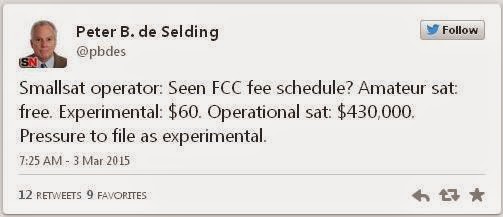
For companies wanting to fly to space under an American "flag," or using American spectrum, there has been a workaround—many satellite manufacturers have pushed to get their satellites classified as "experimental" by the FCC, a designation that makes the licensing process much more straightforward and many orders of magnitude cheaper. Stott says the experimental distinction is, from his perspective, simply semantics.
An experimental license from the FCC also won't work for SpaceX, because experimental satellites technically aren’t supposed to operate for longer than a year or two. SpaceX’s satellites presumably would need to be in space for much longer in order to be useful.
"SpaceX will need to put up a couple satellites to do experiments, of course," Gus Hurwitz, a space law professor at the University of Nebraska, told me. "But it won't make sense for them to use experimental for the entire array. They'll need to reconfigure the constellation for the long haul."
So it's understandable that SpaceX wants the FCC to reform its satellite licensing regulations. The FCC realizes that its rules are currently too complex, and has been trying to lower both the financial and legal barriers to entry for commercial satellite operators. The FCC and SpaceX did not respond to my multiple requests for comment.
While it has asked the FCC to reassess regulations, SpaceX doesn't want the hoops companies need to jump through to be too low. The company's attorneys said the company worries that new regulations might make it too easy for companies to “abuse” the system in the United States, much like they do internationally.
"Spectrum warehousing can be extremely detrimental and unprepared, highly speculative, or disingenuous applicants must be prevented from pursuing 'paper satellites' (or 'paper constellations'), which can unjustly obstruct and delay qualified applicants from deploying their systems," SpaceX wrote.
See, SpaceX isn't the only company that wants to launch broadband satellites. And the company worries that a competitor will be able to launch, say, one satellite, "test" it, and then sit around while it works to procure funding or figure out technical problems, all the while sitting on very valuable spectrum.
 "If a licensee is authorized for 10,000 satellites, the launch of a single satellite after three and a half years is not an indicator that the licensee can successfully deploy the other 9,999 satellites, or even a significant fraction thereof," the company wrote.
And this is where we get some insight into SpaceX's plans. The company proposes that, within six years of being granted a license, any satellite broadband-providing company should be required to launch 75 percent of the total satellites they planned for. So, if SpaceX gets approval for 4,000 satellites, which is a number it's bandied about before, it believes it'll be able to launch 3,000 of them within six years of getting approval from the FCC.
That's a Herculean task. The company might be able to launch more than one satellite at a time—we know virtually nothing about what its satellites will look like, but its various rockets should be able to carry several—but Musk is still looking at a lot of launches, perhaps more than one a week.
Musk has made it no secret that the reusable rocket is key to SpaceX's future plans, and this filing makes that painfully obvious. If he's going to build an array of internet satellites, launches that cost many millions of dollars each are not going to work. And, if he's going to build an array of internet satellites, it appears he wants to do it very, very quickly. The question, now, is whether the FCC sees space the same way he does.

Saturday, March 21, 2015
First 3D printed object in space to created by NASA

Engineers hope that 3D printers can one day be used to build everything from spare parts to tools and even food onboard the space station, as well as on deep space flights to asteroids and Mars just after installation of 3D printer on the International Space Station on Nov. 17,
"This first print is the initial step toward providing an on-demand machine shop capability away from Earth," Niki Werkheiser, project manager for the International Space Station 3-D Printer project, said in a statement. "The space station is the only laboratory where we can fully test this technology in space."
The printer was brought to the station in September on board a SpaceX Dragon cargo craft.
After doing an initial calibration early last week, on Monday engineers on the ground sent commands to the printer to make its first object. On Tuesday, the part was complete and was removed from the machine for inspection.
NASA reported that there might be differences in bonding between different layers in microgravity since it found that part adhesion was stronger in this first printed object than was anticipated. Engineers will research the issue with subsequent prints.
Once the first printing was completed, the space agency's ground team sent commands to fine-tune the printer's alignment. As of Tuesday, printing a second object had not yet been undertaken.
"This is the first time we've ever used a 3D printer in space, and we are learning, even from these initial operations," Werkheiser said. "As we print more parts, we'll be able to learn whether some of the effects we are seeing are caused by microgravity or just part of the normal fine-tuning process for printing. When we get the parts back on Earth, we'll be able to do a more detailed analysis to find out how they compare to parts printed on Earth."
Most of the work testing out the 3D printer is being done from the ground to limit the amount of time astronauts working on the space station need to spend on it, according to NASA. Ground engineers monitor the manufacturing process via downloaded images and videos.
In late spring 2013, NASA chief administrator Charles Bolden talked about the importance of being able to use additive manufacturing, another term for 3D printing, in space. Bolden noted that the technology is critical to enabling astronauts to travel far from Earth and its support systems.
"As NASA ventures further into space, [whether] redirecting an asteroid or sending humans to Mars, we'll need transformative technology to reduce cargo weight and volume," Bolden said last year. "In the future, perhaps astronauts will be able to print the tools and components they need in space."
The technology works by laying down successive layers to create an object, in this case plastic, but metals also can be used.
Made in Space, a company based in the Ames Research Park in Moffett Field, Calif., worked with engineers at NASA to design, build and test the 3-D printer.
NASA is testing ODG smart glasses that would be used by astronauts in space

"The intended purpose and usefulness of glasses like this are unlimited," said Jay Bolden, a NASA spokesman, in an email to Computerworld. "Advanced glasses could aid in navigation, where cockpit displays are broadcast on the goggles in much the same way fighter pilot heads up displays operate today."
Bolden also noted that astronauts on a journey to an asteroid or Mars could use the smart glasses to access chart, map and technical information, instead of having to carry many pounds of technical journals and papers with them.
"For a two-hour flight on a 737 from Cleveland to Dallas, each pilot carries 15 pounds of manuals and that weight isn't really a big deal in the grand scheme," he noted. "However, for a multiple-week mission to an asteroid or the moon, or a multi-year mission to Mars, every pound saved means additional life-critical supplies -- food, water, oxygen, or fuel -- can be shipped in their place."
The smart glasses also could give more information to NASA engineers and scientists working on Earth.
"Real time applications also include the ability for ground support teams to see first hand what astronauts discover and video," Bolden said. "Instead of bringing a 50-pound boulder back for ground analysis, the astronaut can use glasses to scan, measure and catalog where it was found and then chip off a 5-pound sample for ground analysis."
Evaluating smart glasses isn't a new concept for U.S. agencies.
The U.S. Air Force last spring said it was testing Google Glass with pilots, battlefield coordinators and even medics parachuting into battlefield areas.
Glass, which has had its share of ups and downs, is a prototype of smart eyeglasses that Google has worked on for several years.
The ODG smart glasses, which have been in development for six years, are designed to give users the information they could access on a tablet but by overlaying the information on the lens of the glasses.
The glasses also have positional sensors so the device knows the location of the user and where she is looking.
The glasses, for instance, could enable an astronaut to see repair instructions for equipment while keeping hands free to work on maintenance, according to ODG, which also works with the medical, energy and utilities industries.
"As electronic directions and instructions replace paper checklists and longer duration missions are considered, there is a need for tools that can meet evolving demands," said Lauri Hansen, engineering director at NASA's Johnson Space Center, in a statement. "ODG's technology provides an opportunity to increase space mission efficiencies and we are pleased to explore its potential in human spaceflight while also advancing its use here on Earth."
The glasses are being used in a series of tests at NASA's Johnson Space Center in Houston.
Astronauts training to live and work on the International Space Station will use the smart glasses to practice maneuvering around the orbiting station. They also will use them to practice for future space walks.
According to Bolden, the ODG glasses will get a weeklong test this summer when astronauts and mission control will work to simulate a mission to another planet.
NASA has been testing and working with virtual reality technology simulations for the past 20 years, Bolden said.
3D Printed Jet Engine by researchers in Australia
The two engines, created by Monash University and its spinoff Amaero Engineering, are garnering a lot of attention from leading aeronautics companies, including Airbus, Boeing and defense contractor Raytheon, which are lining up at the Monash Centre for Additive Manufacturing in Melbourne to develop new components with 3D printing.

The 3D printed proof-of-concept jet engine on display at the International Air Show in Avalon, Victoria this week.
"Australia's manufacturing industries need access to the latest technologies to stay competitive," Professor Ian Smith, Monash University's vice provost for Research and Research Infrastructure, stated in a news release. "This Centre allows them to rapidly prototype metal devices across a wide range of industries. It's part of a large integrated suite of facilities for research and industry at Monash."
One of the proof-of-concept jet engines was on display this week at the International Air Show in Avalon, Victoria. The second is being displayed at the French aerospace company Microturbo, which originally challenged the university two years ago to build the engines.
The proof of concepts are replicas of an auxiliary power unit used in aircraft such as the Falcon 20 French business jet, which was provided by Microturbo.

The various 3D-printed components of the jet engine.

The detail capable through 3D printing is displayed on the blades of this jet engine turbine.
"The project is a spectacular proof of concept that's leading to significant contracts with aerospace companies. It was a challenge for the team and pushed the technology to new heights of success - no one has printed an entire engine commercially yet," Ben Batagol, of Amaero Engineering, stated in a press release.
The 3D-printed jet engines demonstrate that engineers can produce jet engine test parts in days instead of the months it would typically take through machine lathing and poured-mold parts processes.
The jet engines were printed using an additive manufacturing (3D printing) technique known as selective laser sintering or melting, where a high-powered laser on a robotic head melts metal powder layer by wafer-thin layer.
The engines were printed using the X-Line 1000R 3D printer from Concept Laser, a machine that Amaero calls the largest selective laser-melting (SLM) machine available. The machine is capable of sintering together metal layers anywhere from 30 to 200 microns thick.

Concept Laser
Friday, March 20, 2015
Nasa's Messenger probe orbiting Mercury will soon crash into the planet's surface,
Nasa's Messenger probe orbiting Mercury will soon crash into the planet's surface,

Nasa's Messenger probe orbiting Mercury will soon crash into the planet's surface,
However, by optimising the trajectory design and applying OCMs, the team has managed to delay the inevitable crash.
Experiments carried out with the Magnetometer (MAG) and the Neutron Spectrometer (NS) during this "saving throw" are expected to yield significant results.
They will measure crustal magnetic anaomalies and search for water ice in northern latitudes.
On 18 March, the team conducted the first of the OCMs to allow Messenger to hover possibly until as late as 30 April.
The probe was in an orbit with a closest approach of 11.6kms above the surface of Mercury. With a velocity change of 3.07 metres per second (6.87 miles per hour), the spacecraft's four largest mono-propellant thrusters nudged the spacecraft to an orbit with a closest-approach altitude of 34.5kms.
This maneuver also increased the spacecraft's speed relative to Mercury at the maximum distance from the planet, adding about 1.1 minutes to the spacecraft's eight-hour, 16.5-minute orbit period.
The next manoeuvre, on 2 April, will again raise the spacecraft's minimum altitude.
"We decided on a strategy that includes five manoeuvres in as many weeks to keep the spacecraft within a tight altitude range of 5 to 39 kilometers above the surface of Mercury at closest approach," said APL's Jim McAdams, Messenger's mission design lead engineer.
At periapsis altitude during the hover campaign being 30kms or less throughout the mission, the team hopes to map half the planet with the "magnetic magnifying glass" covering regions never seen at such low altitudes.
The Messenger spacecraft was launched on 3 August 2004, and was inserted into Mercury's orbit on 18 March 2011, to begin its primary mission — a yearlong study of its target planet.
Its first extended mission began on 18 March 2012, and ended a year later.
Extended mission XM2
Messenger is now on a second extended mission, termed XM2-Prime (XM2).
"With MAG, we will look for crustal magnetic anomalies," said deputy project scientist Haje Korth, of The Johns Hopkins University Applied Physics Laboratory (APL), in Laurel. "For instance, we have seen hints of crustal magnetization at higher altitudes (~70 kilometers) over the northern rise in Mercury's northern smooth plains. We will revisit this region at lower altitudes during XM2'. There may be other regions where such signals can be observed, and we will be looking for them," he added.
"With NS, scientists will hone in on shadowed craters at northern high latitudes to search for water ice," Korth said. "We have found such evidence previously in the mission, but we hope to find more at low altitudes and spatially resolve the distribution within individual craters if we are lucky.
"Establishing the presence of crustal magnetic anomalies on Mercury would be a huge result, because it would extend the known temporal baseline for Mercury's internal magnetic field by eight orders of magnitude," he said.
Messenger (MErcury Surface, Space ENvironment, GEochemistry, and Ranging) is a Nasa-sponsored scientific investigation of the planet Mercury and the first space mission designed to orbit the planet closest to the Sun.
The Johns Hopkins University Applied Physics Laboratory built and operates the Messenger spacecraft.
There have been only two missions to Mercury with the first being Nasa's Mariner 10, launched in 1973 and and was in operation until 1975, when fuel was depleted and communication lost.
Messenger is the second probe sent to the tiny planet.
With temperatures ranging between extremes of 400C on the sun facing side to -170C on the other, and a lack of atmosphere, Mercury with a magnetic field and a dense composition is largely a mystery.
Nasa's Messenger probe orbiting Mercury will soon crash into the planet's surface,
However, by optimising the trajectory design and applying OCMs, the team has managed to delay the inevitable crash.
Experiments carried out with the Magnetometer (MAG) and the Neutron Spectrometer (NS) during this "saving throw" are expected to yield significant results.
They will measure crustal magnetic anaomalies and search for water ice in northern latitudes.
On 18 March, the team conducted the first of the OCMs to allow Messenger to hover possibly until as late as 30 April.
The probe was in an orbit with a closest approach of 11.6kms above the surface of Mercury. With a velocity change of 3.07 metres per second (6.87 miles per hour), the spacecraft's four largest mono-propellant thrusters nudged the spacecraft to an orbit with a closest-approach altitude of 34.5kms.
This maneuver also increased the spacecraft's speed relative to Mercury at the maximum distance from the planet, adding about 1.1 minutes to the spacecraft's eight-hour, 16.5-minute orbit period.
The next manoeuvre, on 2 April, will again raise the spacecraft's minimum altitude.
"We decided on a strategy that includes five manoeuvres in as many weeks to keep the spacecraft within a tight altitude range of 5 to 39 kilometers above the surface of Mercury at closest approach," said APL's Jim McAdams, Messenger's mission design lead engineer.
At periapsis altitude during the hover campaign being 30kms or less throughout the mission, the team hopes to map half the planet with the "magnetic magnifying glass" covering regions never seen at such low altitudes.
The Messenger spacecraft was launched on 3 August 2004, and was inserted into Mercury's orbit on 18 March 2011, to begin its primary mission — a yearlong study of its target planet.
Its first extended mission began on 18 March 2012, and ended a year later.
Extended mission XM2
Messenger is now on a second extended mission, termed XM2-Prime (XM2).
"With MAG, we will look for crustal magnetic anomalies," said deputy project scientist Haje Korth, of The Johns Hopkins University Applied Physics Laboratory (APL), in Laurel. "For instance, we have seen hints of crustal magnetization at higher altitudes (~70 kilometers) over the northern rise in Mercury's northern smooth plains. We will revisit this region at lower altitudes during XM2'. There may be other regions where such signals can be observed, and we will be looking for them," he added.
"With NS, scientists will hone in on shadowed craters at northern high latitudes to search for water ice," Korth said. "We have found such evidence previously in the mission, but we hope to find more at low altitudes and spatially resolve the distribution within individual craters if we are lucky.
"Establishing the presence of crustal magnetic anomalies on Mercury would be a huge result, because it would extend the known temporal baseline for Mercury's internal magnetic field by eight orders of magnitude," he said.
Messenger (MErcury Surface, Space ENvironment, GEochemistry, and Ranging) is a Nasa-sponsored scientific investigation of the planet Mercury and the first space mission designed to orbit the planet closest to the Sun.
The Johns Hopkins University Applied Physics Laboratory built and operates the Messenger spacecraft.
There have been only two missions to Mercury with the first being Nasa's Mariner 10, launched in 1973 and and was in operation until 1975, when fuel was depleted and communication lost.
Messenger is the second probe sent to the tiny planet.
With temperatures ranging between extremes of 400C on the sun facing side to -170C on the other, and a lack of atmosphere, Mercury with a magnetic field and a dense composition is largely a mystery.


